
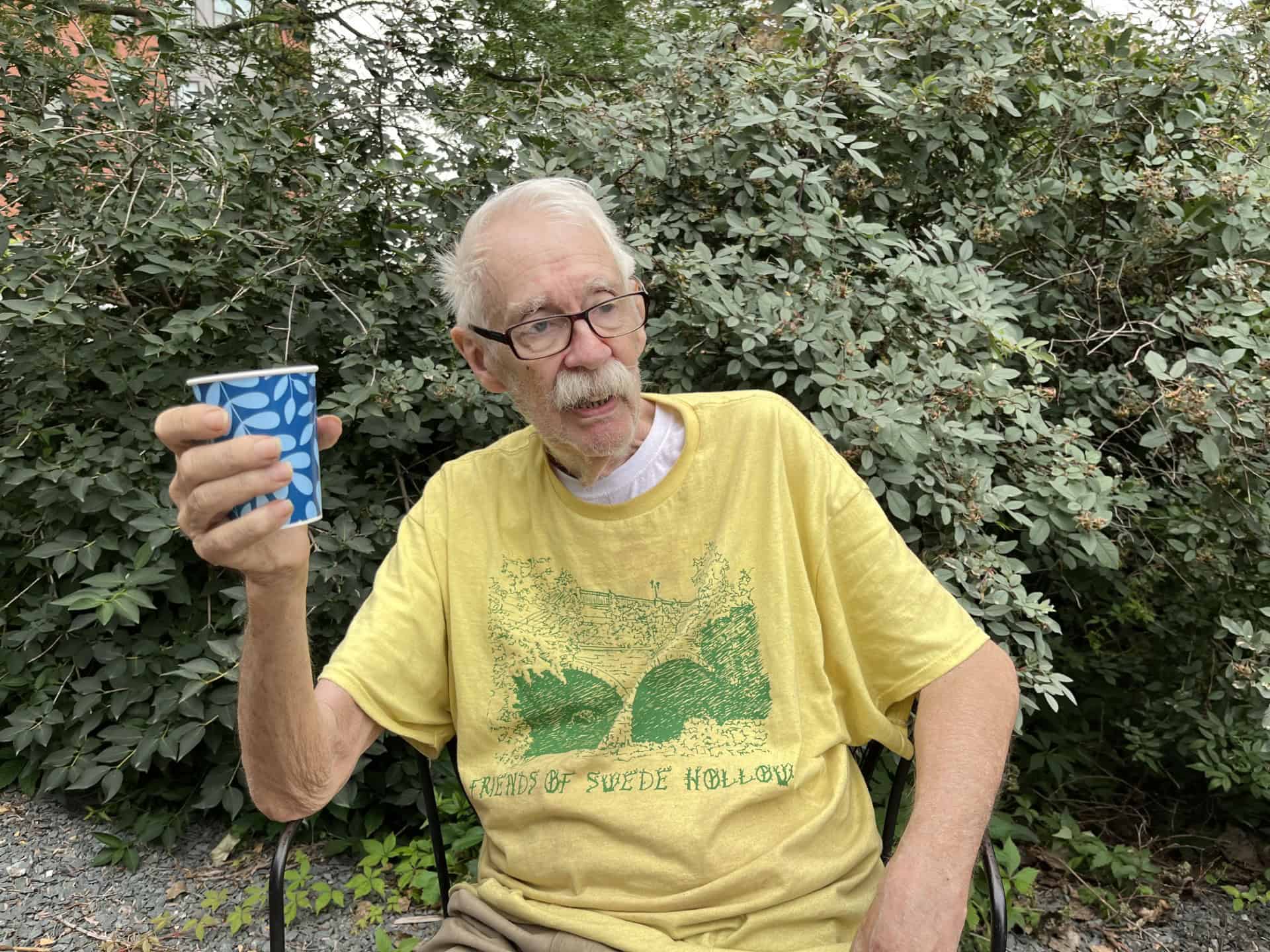
It’s a natural fit for Steve Trimble to be drawn to St. Paul’s historic Swede Hollow.
The retired college professor, author and former Minnesota state legislator is all about urban history. He developed his interest while he was in grad school at the University of Chicago.
Trimble, 81, was named the Saint Paul Parks Conservancy’s 2024 Volunteer of the Year for Swede Hollow Park. He’s a member of the Friends of Swede Hollow group, which meets monthly and works to protect the natural beauty of the area and remember its past. He produced a brochure about Swede Hollow’s history to distribute at the annual “Art in the Hollow” event in June.
It doesn’t take much prompting to get Trimble talking about Swede Hollow, which he says he discovered shortly after moving to the Twin Cities to teach at Macalester College in 1969.
In a piece titled “The Saga of Swede Hollow” that Trimble wrote for “Historic St. Paul,” he describes the area where Swedish immigrants started settling in the 1860s: “Some say it was a slum, while others think it was a nurturing community that welcomed waves of immigrants to their first home in a new land. It was not large – around 18 acres – bisected by a creek and tucked into a valley with 60- to 80-foot-high cliffs that hid its homes from the outside world.”
It was never totally Swedish at the beginning, Trimble says, but those Nordic immigrants made up most of the population in Swede Hollow and nearby West Side Flats.
“At one time, there were probably 1,000 people living in the Hollow, with houses going up the hill,” Trimble says on a warm summer day at (where else?) the Swede Hollow Cafe. In the early 1900s, Italian immigrants moved into the area; after World War II, Mexican-Americans moved in.
When looking at urban history “you do a lot of ethnic history,” Trimble says.
“Swede Hollow was not a beautiful place, but it was for someone who doesn’t have a lot of money,” Trimble says.
Phalen Creek, which runs through Swede Hollow, used to be bigger, he says, coming out of Lake Phalen and heading to the Mississippi River. In the 1930s, much of the water was piped away.
The residents on the steep sides of the hollow had outhouses over the creek, Trimble says. Several large springs provided water for drinking and cooking.
In “The Saga of Swede Hollow,” Trimble writes about the last houses in Swede Hollow.
In December 1956, the city health department decided that since Swede Hollow had no sewer or city water service it was a health hazard. The last 14 families were moved out and the remaining homes burned down by the fire department. Thanks to the efforts of Friends of Swede Hollow and the City of St. Paul. the hollow has been revitalized and is once again a center of the community.
Swede Hollow was designated a St. Paul Park in 1973.
In his work with Friends of Swede Hollow over the years, Trimble says he fought construction of a freeway, a landfill dump and condo development in the area.
Trimble’s books include “Remembering St. Paul” and “Historic Photos of St. Paul.” But his focus isn’t solely on St. Paul. His 1988 book “In the Shadow of the City” is a history of Minneapolis’ Loring Park. He writes for the Dayton’s Bluff community newspaper.
Trimble was born in Emporia, Kansas, “what we would call a small town,” he says. But the town of 12,000 is Kansas’ sixth-largest. He did his undergrad work at Southern Methodist University in Dallas.
Teaching at Macalester for four years starting in 1969, Trimble’s focus was on urban history, medical history and radical movements. After four years there, Trimble worked at a community college helping older people who hadn’t finished their degrees to earn credits nights and weekends. He worked with urban history programs at Metro State and was the first to do oral histories in class, he says.
Trimble, who lives near Indian Mounds Regional Park in St. Paul, served in the Minnesota House (District 67B) from 1987 to 2000. The DFL representative said people were often surprised that he had agricultural interests during his time in the House.
“Everybody in my district eats food,” he would reply.
Trimble says volunteers are important. “You have to have non-professionals help the neighborhood. Otherwise, who’s going to do stuff?”