Mississippi River Learning Center FAQ
Frequently Asked Questions (FAQ)
Site Location and Environment
Will the project harm the surrounding environment?
We are restoring a disturbed environment by removing invasive species and debris from previous construction, protecting significant trees, improving habitat, and reintroducing native plants that thrive within this dynamic river system.
Why are trees being removed?
Some trees and shrubs were removed in April 2025 to allow access for soil and geotechnical testing, which is needed to plan the project and determine clean-up needs. Most of the removed trees were non-native or invasive, and efforts were made to protect significant trees.
As the project moves forward, more tree removal will be needed to restore the site’s natural ecology. This includes removing invasive species, fill soils, and construction debris. The goal is to replace these with native plants, create stable slopes, and protect existing significant trees.
Is this building in a flood plain? What are you doing to protect the building from floods?
The River Learning Center site is a part of a dynamic river system with waters that fluctuate seasonally. The proposed buildings and site design will be focused on working with these natural forces. Proposed buildings and major site features will be located above critical flood zones while other site trails and spaces will be inaccessible during these high water events.
Will the trail system be changed?
Existing trails will be reconstructed to improve connections to the wider community and river park system. New accessible trails will improve access to the greater site and waters edge, while still preserving more natural trails for site exploration and connection to the floodplain.
What is going to happen to the Watergate Marina and the people who live there?
The Watergate Marina remains an important place within the River Learning Center site. The residents, boat owners, and operators have been engaged during the design process. The existing building structures will be replaced and the slips on the west edge of the marina bay will be removed in order to improve public access to the river. A new cafe building is proposed to be constructed on the existing Marina site. The boat slips, boat launch, and gas station will remain.
It’s hard to find the marina. Do you think people will be able to find the River Learning Center?
New ADA accessible trails, increased parking, and wayfinding signage will ensure that the River Learning Center can be accessed by visitors arriving on foot, bike, or car. A study of Shepard Road will be conducted in 2025-26 to enhance traffic flow and improve public access from surrounding neighborhoods.
Native American Engagement and Significance
This area is significant to the Dakota people. Have you consulted with tribes?
The Great River Passage Conservancy has cultivated long-term relationships with tribes since its formation, and as we move into the final design and construction phases, we are continuing to prioritize Native communities to ensure this project is respectful to the land’s history and significance to Dakota people.
Are there burial mounds or other sacred sites in the vicinity of the project? How will you care for them?
It is our responsibility to work with Native communities to understand and evaluate the site from a cultural perspective. Our community engagement partners have compiled a report on significant Dakota sites in the area, and our historical consultants have conducted an archaeological survey to assess the site’s history.
How will the ongoing management of the property take Native values into consideration?
From the very beginning, we have engaged with tribes, the Minnesota Indian Affairs Council and Native organizations on a cultural, spiritual and programmatic basis. Our goal is to manage this space in a way that reflects native values and has minimal impact on the river and the environment.
Operations and Programming
Who will own the River Learning Center? How will it be managed?
The City of Saint Paul will own the River Learning Center, with tenants such as the National Park Service and Mississippi Park Connection leasing space. The management structure will be similar to some of our other partner sites, such as the Wellstone Center and the Wakan Tipi Center, where the city will own the property and partners will manage and maintain it.
What programming will be offered at the site?
The River Learning Center will be a statewide asset with year-round programming that honors, promotes stewardship of, and teaches the culture, history, and ecology of the river. Programs will be rooted in authentic hands-on experiences to learn from and with the river. The City and a variety of partner organizations will offer programming at the site, from boating to ecology to cultural experiences.
How are you making the building and programming accessible to people with disabilities?
People of all backgrounds and abilities should be able to access the river, and we will strive to accomplish this at the River Learning Center. All buildings constructed will be ADA accessible and use Universal Design Principles. A variety of programming will be offered to ensure that opportunities exist for everyone.
Will programming be affordable?
The City of Saint Paul, National Park Service/Mississippi Park Connection, Wilderness Inquiry and all our programmatic partners are committed to improving access to the river for people of all backgrounds. Offering affordable programming is one important way to accomplish this.
Will you have cultural and diverse programming at the site?
River Learning Center programs will celebrate the evolving culture of the river locally and nationally. The programs will create and deepen the relationship between people and the river, exploring river heritage to actively create the contemporary and future culture of the Mississippi River.
Does the federal government support having the National Park Service’s Mississippi River Headquarters here?
Representative Betty McCollum, who chairs the House Interior-Environment Subcommittee, has expressed support for the project. The City of Saint Paul and National Park Service have a Partnership Agreement which identifies the City of Saint Paul as the owner and project lead and the National Parks Service as the tenant and project partner. This agreement solidifies the federal government’s support for the project.
Process
Where in the process is the project currently?
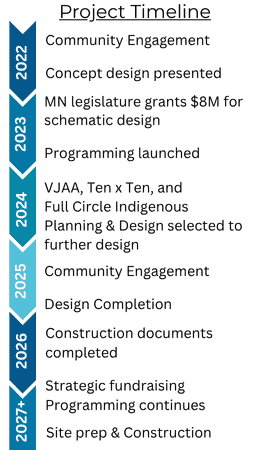
This past summer, the project team completed 18 community engagement events, tribal engagement events, and focus group sessions gathering input from a broad range community voices. The Environmental Assessment Worksheet, archeological, and historical assessments have been completed. In coordination with the DNR, the design team is conducting Rare Species surveys on the site. The project, lead by architecture firm VJAA and landscape architects TENxTEN, is currently in the 95% documentation phase.
How did this project come about? Has the community had any input on the project?
The River Learning Center was first envisioned in the Great River Passage Master Plan, which was adopted by the Saint Paul City Council in 2013. Significant community input was conducted as part of the planning process. The City of Saint Paul and Great River Passage Conservancy also conducted community engagement in 2022 as part of the schematic design process along with their design and engagement partners, W Architecture and 106 Group. To learn more, visit River Learning Center wins 2023 American Architecture Award!
In 2024 and 2025, various arts-based engagement events and pop-ups were held by Forecast Public Arts, with an emphasis on gathering perspectives and stories connected to the Bdote. Young Environmental Consulting Group provided family-friendly activities and opportunities to experience the park and water including a river cruise. NewPublica hosted eight (8) programming-specific focus groups, seeking design feedback and programming input water and trail users, national park visitors, nearby residents, and those previously engaged. To continue to weigh in, please fill out the feedback survey here.
How much will the project cost? How will it be funded?
The cost of the project was estimated at approximately $60M during the schematic design process. Public and private dollars will fund the project.
How much taxpayer money will go toward maintaining the building?
While the maintenance costs have yet to be determined, much of the ongoing upkeep of the building will be funded by revenue from tenants who lease the space.
Why should taxpayers fund this project?
The project will be funded by a combination of public and private dollars. The River Learning Center will be a statewide asset. It will serve as the gateway to the Mississippi River, welcoming residents and visitors to this national center and parks headquarters with four-season programming that honors, promotes stewardship, and teaches the culture, history, and ecology of the river.
Will TIF be used for financing?
Tax Increment Financing will not be used to fund the River Learning Center.
When will the River Learning Center open?
The timing for when the River Learning Center will open is yet to be determined.